

Hey. Today I got Penta SATA HAT for my RaspberryPi5 (8GB) and I am a little worried to bend cooler. Can someone explain to me if it is safe to remove completely or bend those 3 fins (I think that’s what they are called) on my active cooler. I forgot or skipped this part in Michael Klements video and now I am kinda afraid what can happen if I bend those things on. As you can see on picture I bend it a little but my tools are too large. I am going to town buy a new thinner one.
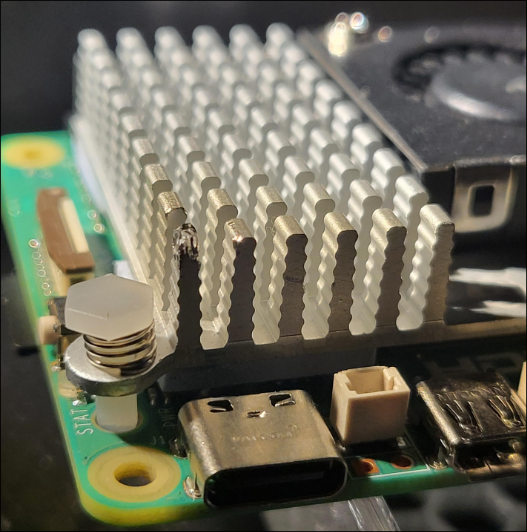
- Here someone bend them a little → Bending them off
- Here he removed them completely → Removing fins
- Removed → I CREATED A PI NAS With RAID 5 Setup | Radxa Penta Sata Hat for SSD🔥
- Bend v2 → The ULTIMATE Raspberry Pi 5 NAS
- Removed → I Built A 4-Bay NAS Using A Raspberry Pi 5
Oh and I am looking for recomendation for disks im not too technical but I get I need to I have 4x2,5SATA slots and 1x3,5SATA. I seen people using Crucial 1TB 2,5" SATA SSD BX500 which seems pretty reasonable in price. I am have docker, docker-compose and podman/ podman-compose of:
- Immich
- Jellyfin
- Navidrome
- (planning on NextCloud)
- (planning on OpenMediaVault) I connect them with Tailscale but looking for switch to NGINX something with my domain (but I need to buy one lol).
Just pop the heatsink off and do it.
A heatsink works by increasing surface area to dissipate heat through convection (air moving past it) and radiation (infrared energy). The key principle is:
Heat dissipation ≈ Surface Area × Temperature Difference × Heat Transfer Coefficient
but, for me, math is hard, so…
Why You Can Cut Fins Off (Usually)
- Diminishing Returns: Each fin you add provides less cooling benefit than the previous one because:
- Inner fins get less airflow (they’re shielded by outer fins)
- Heat has to conduct through more material to reach outer fins
- The temperature gradient decreases as you move away from the heat source
- The Rough Rule: A heatsink typically operates with 30-50% margin. So if it’s rated for 5W and your RPi CPU draws 3W, you have room to lose some fins.
- Fin Efficiency: There’s actually a mathematical concept called “fin efficiency” - fins that are too long or too closely spaced become ineffective. The last row of fins might only contribute 10-15% of total cooling.
Napkin Math Example
Say you have a heatsink with 8 fins:
- First 4 fins: ~60% of cooling
- Next 2 fins: ~25% of cooling
- Last 2 fins: ~15% of cooling
Cutting off one row (2 fins) loses maybe 10-12% of cooling capacity. If your CPU was running at 65°C with the full heatsink, it might now run at 68-70°C - usually fine since RPi CPUs throttle around 80-85°C.
When You Can’t Cut Fins
- If the heatsink was already barely adequate
- If you’re overclocking
- If ambient temps are already high
- If there’s no airflow
The real question to ask: “What’s my current CPU temp under load?” If it’s 60°C, cut away. If it’s 78°C, maybe find a different heatsink.